I have a gorgeous rocker/glider in a faux Black Forest style that’s being smothered by my discarded outfits in my bedroom. It’s being treated as a glorified valet chair – this is entirely beneath its worth. I’ve been wanting to move the rocker downstairs – but let’s be honest – I’m always gonna need a ‘transitional zone’ for clothing – a textile dump.
I’d seen old dining chairs made into benches and that’s what I fancied. Depending on the design, it might include cutting the chairs – so I was on the hunt for a pair of chairs with some visual interest to ‘upcycle’. I prefer to upcycle things that already need some work and I found a great pair of rush-seated chairs at a good price on eBay. The rush seating was frayed and broken – and would need to be replaced to be a usable seat or temporary home for clothes.
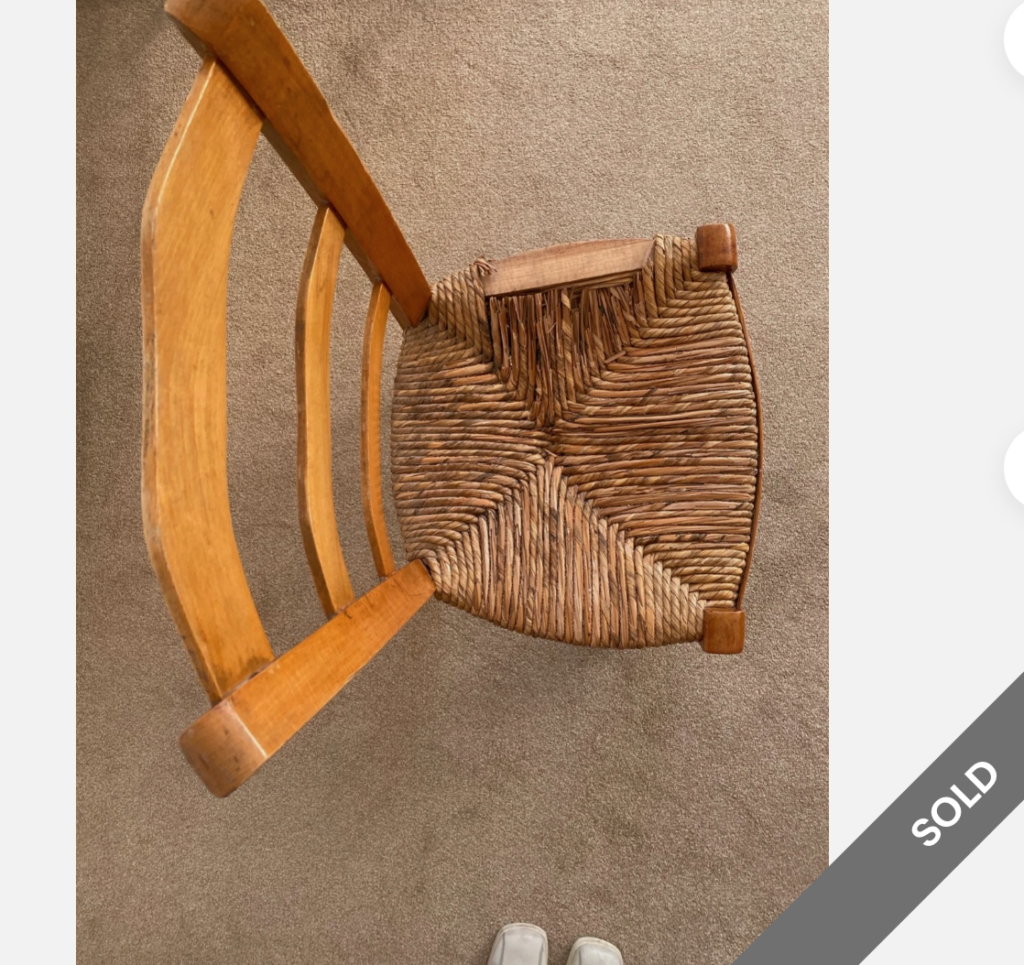
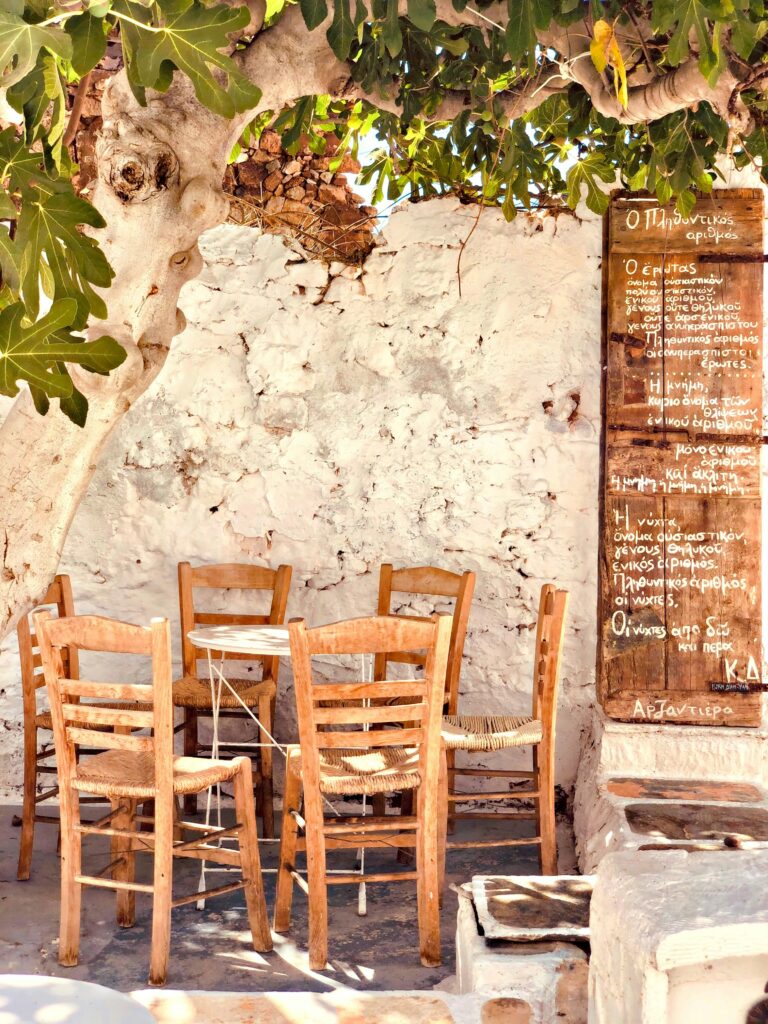
When I picked up the chairs, I got more than just seating. The woman who sold me the chairs told me that her father had commissioned twelve chairs in Cyprus in anticipation of leaving for England in the mid 1960s. These chairs had survived exile and immigration – they’d been witness to family meals in the old country and the new. I imagine that even though they’d been told not to on multiple occasions, kids and grandkids had tipped back in those chairs when adult chat had gone boring or into Greek they’d only partially understood. Someone had likely stood on these chairs to reach something on a high shelf, even though that’s safe for neither chair nor human. Despite the knocks of everyday life, some of the 12 are still in service today. I did some Googling and found out that these are traditional Cypriot chairs – lightweight but sturdy. Comfy chairs designed to have replaceable elements. But not upholstery fast fashion – some of the rush seating is still in good nick 60 years later.
As I took the first step, removing the old broken rush I imagined how I could use them. I thought about how these chairs were part of this family’s story, the troubled recent history of Cyprus and the pain of disconnection. I knew I couldn’t cut these chairs to make my ‘bench’.
I digress: – a Mid-century Modern history of Cyprus:
OK not just the 20th century, but 19th. Following the Russo-Turkic war (Charge of the Light Brigade, Florence Nightingale, Crimea and so on…) Cyprus was governed by the British Empire but still nominally under the power of the flagging Ottomans. The island’s position is strategically vital – the furthest east big island in the Med, tucked into the corner where Turky and Syria meet and not too far from Egypt and the Suez Canal. So while empires were shoring up their power, it was also a time of rising national consciousness and identity defined by common language, religion and some dodgy race science. Not just in Cyprus or Greece, but across Europe and further afield.
The post WWI collapse of the Ottoman Empire (they picked the wrong side) and a general idea of re-drawing disputed territories based on those principles of nationhood and self-determination (but not too much self-determination – many of these areas remained under the control of the victorious imperial powers) there was a move of populations (1.5 million Greek speaking Orthodox Christians migrated from the areas now in Turkey) and lines on maps.
Cyprus was annexed by the British in 1914 and stayed under British mandate via the Treaty of Lausanne after WWI. But the concept of nationhood and the glory that was Greece became the idea of Enosis – union – the creation of a greater Greece – very much like the ideas of Polish, Greater German, Balkan, Czech, Zionist and Arab – to name just a few – were also strengthening. In 1960, Cyprus became independent, but the idea of enosis did not die and there was an increase in violence and tension between the Turkish Cypriots (Muslim – presumably Turkish speaking) and Greek Cypriots. In 1974 a Greek sponsored coup d’etat was met by a Turkish invasion and subsequent partition of the island along with population transfer. Throughout this period, a Cypriot diaspora emerged – mainly but not exclusively settling in the UK. Mostly in North London, which sadly means fewer Cypriot restaurants, cafes and delicatessen for me here in South London. People left homes to which they could never return, taking their photos and their chairs with them.
Weaving the chairs:
I knew the chairs needed to be able to return to their original form, so whatever I did had to be non-destructive and reversible. I also felt I wanted to honour the woven rush seating – but I had zero desire to mess around with that. Wool though – wool I can work with.
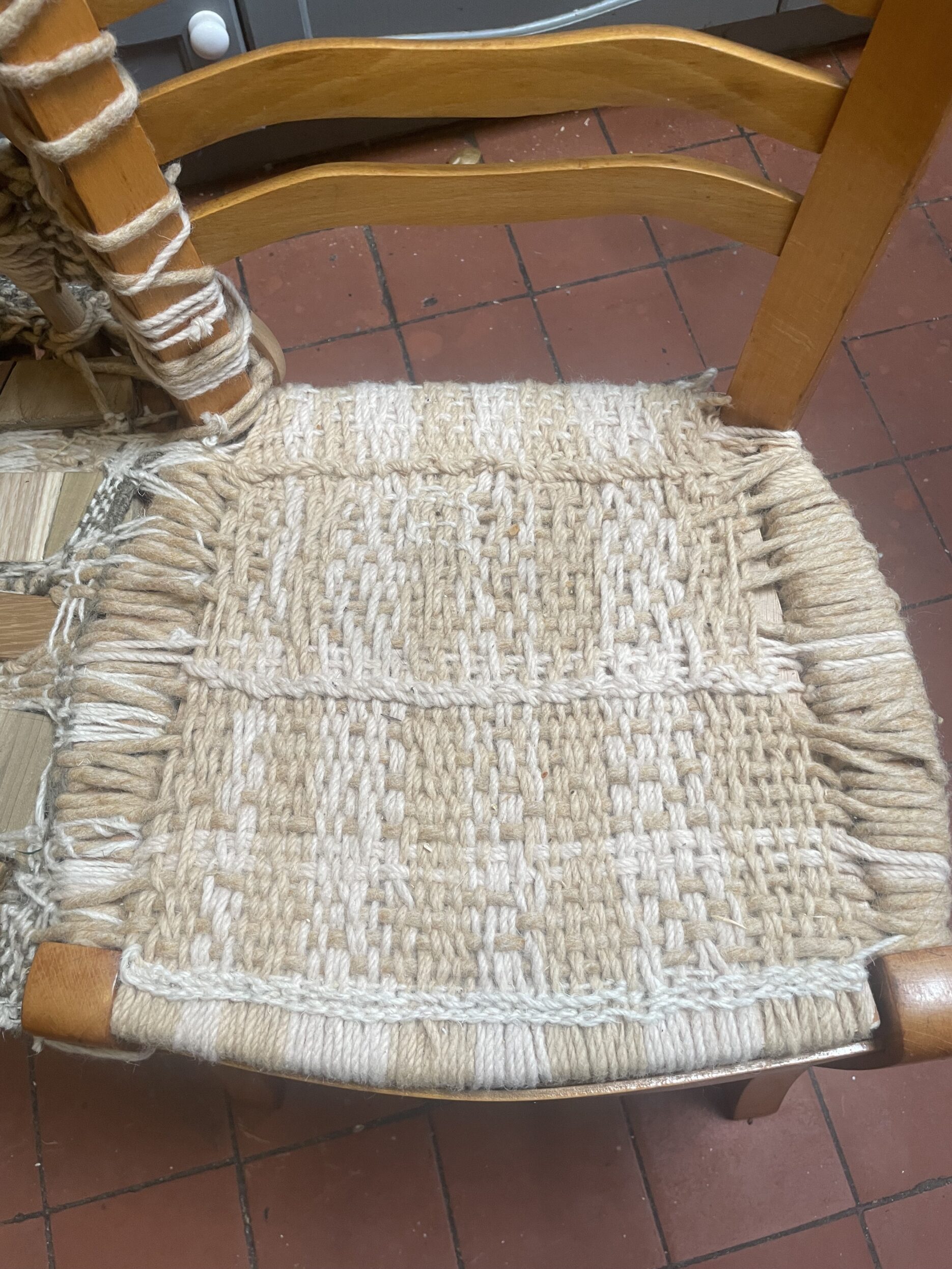
For one of the chairs, I created a plywood seat which sits in the frame and wove a wool covering over the top in muted neutrals. For the other, I used offcuts from my desk project to make slats supported by old wooden coat hangers and I tied the chair together with chunky yarn and felted cord. In my mind I thought about how patterns of life are disrupted, perspectives change and purpose is re-framed. The weaving changes, it’s chaotic, it incorporates new threads, new substances – but there is still pattern that incorporates the original material with ties to the old. It’s connection without enosis.
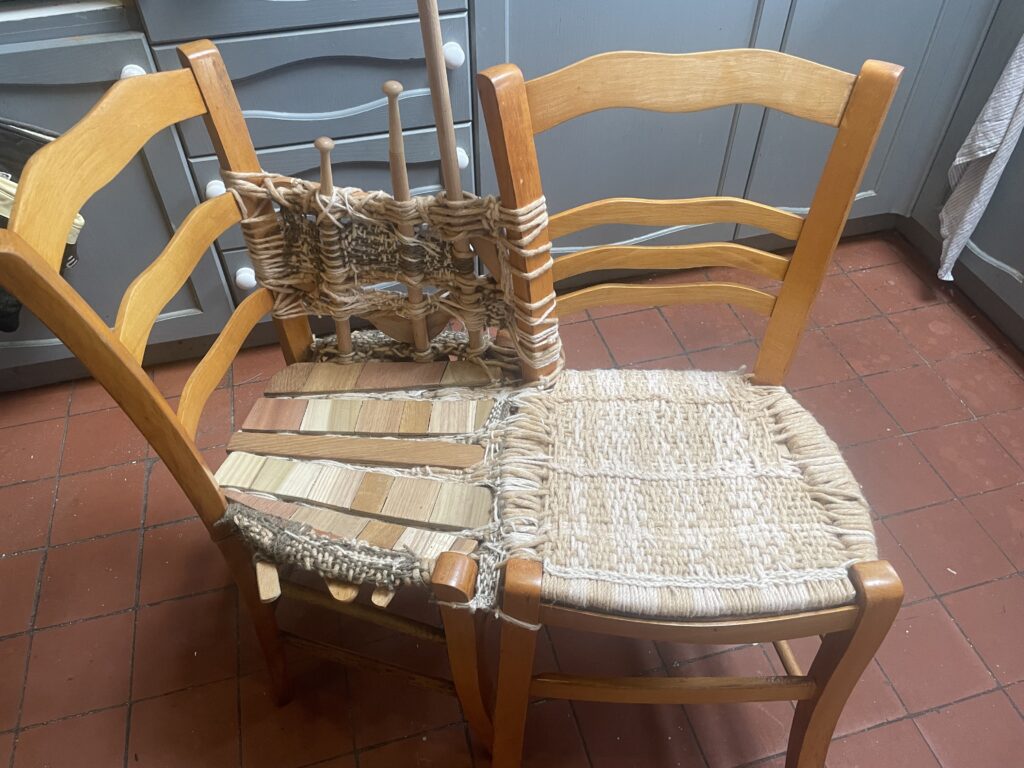
And yes, my bedroom valet chair is still a valet chair. It has a functional seat and a place to dump and drape clothing. But it’s also a representation of change and loss and finding new ways – a diaspora bench.